


[TLDR: We’re going to “there’s no ethical consumption under capitalism” ourselves to death.]
One random day, I came across a video of a family in Mansfield, a rural area of Georgia, who now have sediment-filled well water, a doubled electricity bill, and very low water pressure after one of Meta’s data centers came to town. And I can’t unsee it.
Another day, I heard that Elon Musk’s data centers are polluting the air in Memphis, Tennessee, particularly in Black neighborhoods. I can’t unhear it.
Video: We Went to the Town Elon Musk Is Poisoning
And yet, the first link I just shared above is to a video on Meta’s platform, Facebook. I just received a (rare) package from Amazon, a company with a well-documented history of labor code violations and other gross billionaire behavior. I just came home from my job in the tech industry, where AI reigns supreme.
I have well-founded concerns about AI’s impact on the environment and human cognitive function, and I also know that none of our consumption can be pure and perfect, free from corruption or questionable ethics, in the society we live in, whether it’s where we shop, whether we use or manage to avoid generative AI, or how we choose who to vote for in a broken, limiting two-party political system. I don’t hold myself or anyone else to the expectation of faultless choices or an unblemished existence.
My issue is with apathy. How can we see limited water access, environmental racism by way of poisoned towns, and cognitive atrophy and not—as our mildest reaction—think twice about using generative AI?
Is there a middle ground between spending every hour of the day trying to be a perfect consumer (which I believe is impossible) and being the type of person who shrugs at any mention of the harm caused by some of the things we consume?
I want to believe there’s a balance and a better way.

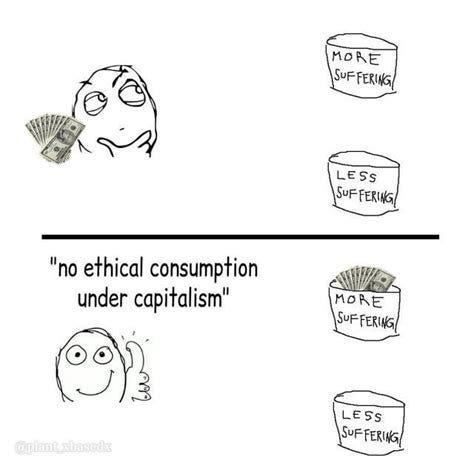
As a society, we’ve become too good at spitting out phrases to absolve us of any personal responsibility for what happens in our world, from “I don’t do politics” to “There’s no ethical consumption under capitalism.”
The latter phrase is mostly good and true, but often misused. “There’s no ethical consumption under capitalism” should keep us from feeling overwhelmed with guilt when a barista hands us a plastic cup or from feeling the need to look up which political party every popcorn brand has donated money to when we just want to buy a bag of popcorn. It should not, however, be a blanket excuse to never make a more ethical choice when it’s possible and reasonable to do so.
Peter Coffin, in an essay on AI through a critique of this phrase, said:
“Relying on overly simplistic slogans…reduces complex socio-economic and technological issues to black-and-white statements.
…This approach tends to frame issues in a binary manner — good vs. bad, ethical vs. unethical — without acknowledging the spectrum of possibilities and the multifaceted nature of technological impacts in society. It suggests a world where any action within a capitalist framework is inherently unethical, which is a statement that is bound to fuel nihilism. Why do anything if it’s all bad? If things I must do make me bad, why should I try to be good?”
“I don’t do politics” is an even more dangerous stance to take, in general and when it comes to AI.
AI is in the hands of the public, and I’m not so naive to think we can squeeze that toothpaste back into the tube. But as with many issues that plague society, the onus to reduce AI’s negative effects isn’t 100% on individual consumers.
Not caring how something affects someone else as long as it seems to make life easier, faster, cooler, etc. feels as American as apple pie. This disturbs me, but doesn’t surprise me. This is where I expect our government to step in: to regulate AI, pass legislation to mitigate environmental impacts, and encourage people (especially children) to protect their humanity, safeguard their brain function, and avoid becoming reliant on it.
The people at the top are the ones who can, for example, make it so that a mom who wants AI to tell her whether she looks good in light blue or write an email to her child’s school principal won’t be the reason someone else doesn’t have clean air or water or is forced to live with constant, high-pitched data center sounds that would drive most of us out of our minds.
But the government’s responsibility shouldn’t make us feel free to dismiss or ignore the plight of our fellow humans, like those who can’t flush their toilets without pouring a gallon jug of water into the back tank because there’s a data center in their neighborhood or the victims of deepfake revenge porn. We all have to decide for ourselves who to vote into office. When we do, I hope we remember them.
Like it or not, generative AI is here, and while we may not be able to personally stop every billionaire or scammer profiting from it in evil ways, we can hold our government’s feet to the fire for responsible regulation. It’s the very least they can do.
The very least we can do is give a damn. As I said to my bar-hopping ex at the beginning of the pandemic, “I don’t know how to explain to you that you should care about other people.”
Saving the whole world isn’t on our shoulders as individuals, but we do have a moral responsibility for the choices we make. Even so, despite what the most aggressive and annoying talking heads on the internet may try to imply, we don’t instantly become bad people for choices like shopping at Walmart or Amazon when it’s the best (or only) option where we live.
There has to be nuance. We should all do the best we can, and thankfully our options aren’t between indifference and scoring 100 on a made-up test about patronizing ethically pristine corporations (does such a thing even exist?).
We didn’t ask to be born into this system, and we’ll make mistakes as we try to survive in it, but our personal values and convictions should always guide the way. If yours include being a kind, considerate person who cares about their community (or “the least of these”), thinks critically, and consumes as ethically as possible, honor that even in choices that may seem small, like how you use (or don’t use) the latest technology, to the best of your ability.
We can’t be perfect. We can try to apply our values and convictions to the ways we spend money and move through the world. All our humanity demands of us is to try.

Shannon,
This is so good and comes at a time where I think the vast majority of people have thought about some of these things and even seen similar videos, but have generally just folded to the system. Operating under some type of thought process that them making small choices in how they use AI, where they shop, etc. doesn’t have enough impact to change anything.
For many of us, AI has come and changed the landscape of our everyday work. Not only having to make considerations for it, but having an actual managerial mandate to use it and use it effectively. As a solo marketer for 200 person organization AI has allowed me the ability to pass off some of my more menial tasks and focus on more critical and strategic work.
But I think you make a good argument that none of us can be perfectly ethical consumers, it’s simply making thoughtful choices every day with others well-being at top of mind when we use these tools and make purchases.
I intentionally don’t follow any of the current administration or the White House’s social media channels but I was served an undeniably-AI created video from the White House’s page the other day. And I thought to myself, “How many gallons of water did it take to produce this actual slop?”. Not only did it infuriate me from a political standpoint but it caused me to stop and think about the exact implications you describe.
Thank you for your words here 🫶